Ponente — Imperia: A Tale of Two Cities
by Joseph Harris
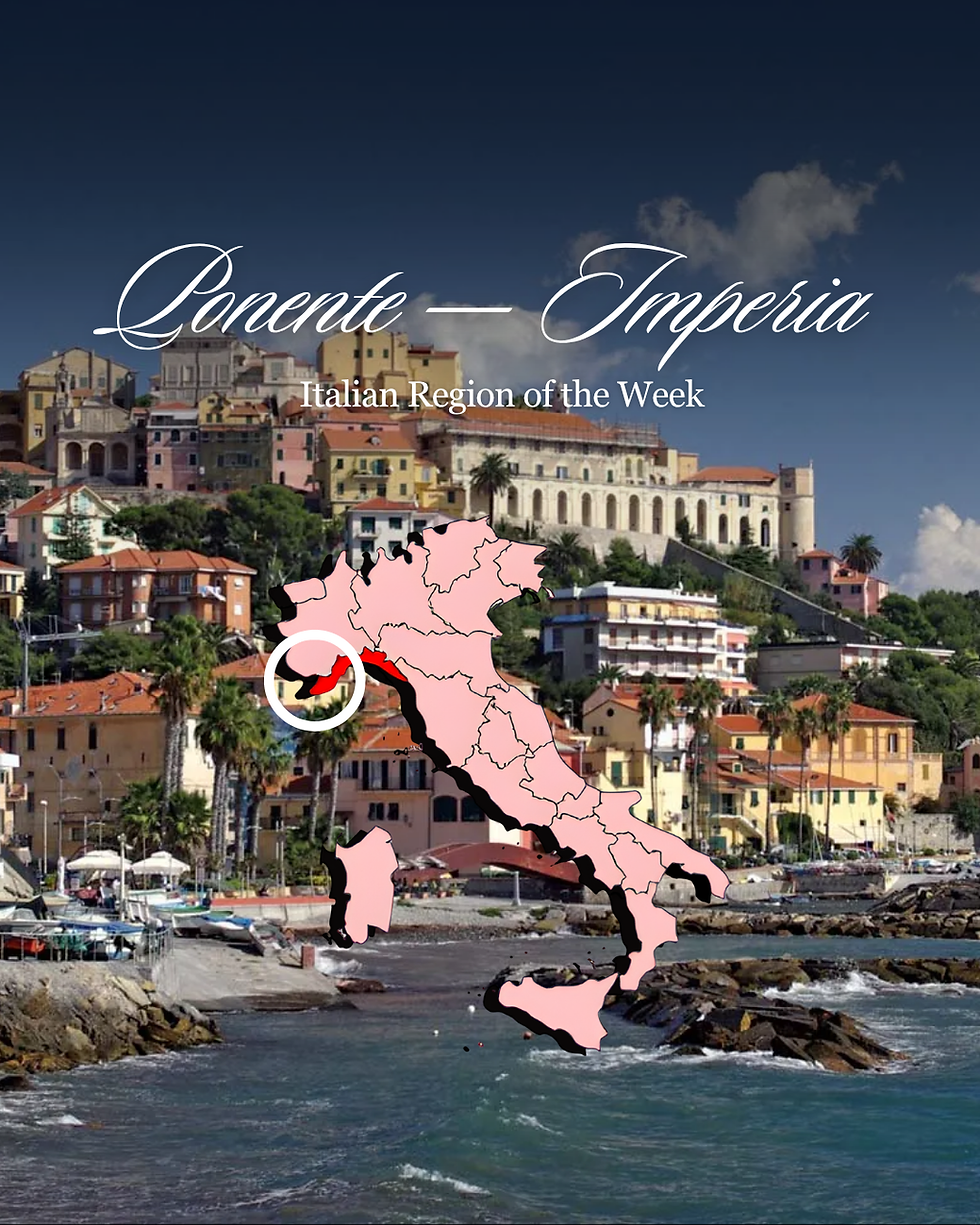
In April we went to Liguria and stopped, as everyone stops, in Genoa. That was Beppe's night, the pesto, the marble mortar, the memory of a grandmother's kitchen above the Ligurian Sea. Tonight, we return to the same region and drive the other way, west along the narrowing coast toward France, to the end of Italy. Except that calling it the end of Italy assumes the border means something. Here, it never has.
Begin at the end. In 1923, Mussolini took two towns that had spent three and a half centuries disliking each other across a small stream, Oneglia on one bank, Porto Maurizio on the other, and welded them into a single city by decree. The locals could not agree on a name for the arranged marriage; a proposed 'Portoneglia' was refused by both sides, so a neutral name was imposed from above, borrowed from the stream between them: Imperia. The regime liked that it rang of impero , empire. What the regime evidently did not know is that the name was never neutral at all. For six centuries the stream had simply been called Oneglia's water, aqua Uneliae in the old documents. It only became the Impero in the sixteen-hundreds, when the two banks belonged to two sovereigns and mapmakers needed a word for the line where the Empire's ground ended and Genoa's began: the imperial creek. The rivalry named the river. And so the new city, meant to bury the division under a single flag, was christened, by accident with the word for the border between its halves. To understand Imperia, you have to meet its ancestors, the two rival bloodlines on either side of that creek. And to meet them, you have to go back to the wars that made them enemies in the first place.
Liguria is ground zero between France and Italy, and the western half of it, the Riviera di Ponente, the coast of the setting sun, is culturally a piece of Provence that happens to fly an Italian flag. The proof is thirteen miles of shoreline: Monaco's own language, Monégasque, is a Ligurian dialect, carried there by the Genoese Grimaldi in 1297 and still spoken on the Rock. Nice's dialect, Niçard, is Provençal. A Ligurian-speaking principality and an Occitan-speaking French city sit within sight of each other, and neither is a colony of the other. This is not a frontier. It is a seam.
The history of the seam is a history of flags that would not stay put. Charles VIII of France came over the Alps in 1494 and opened sixty-five years of the Italian Wars, and from that moment northern Italy stopped being a place that governed itself and became the board other people played on. Genoa spent thirty years as a French dependency until 1528, when Andrea Doria, the greatest admiral of his age, born in Oneglia, switched his fleet from the King of France to the Emperor and decided, personally, which empire this coast belonged to. In 1576 his family sold Oneglia to the Duke of Savoy, whose court in Turin conducted its business in French. The town spent the next two and a half centuries answering to French-speaking masters while Porto Maurizio, across a small stream called the Impero, stayed loyal to Genoa. Two towns, a few hundred yards apart, in two different countries, glaring at each other across a creek. Dickens needed London and Paris and the width of a channel to tell a tale of two cities. This coast tells the same tale across a stream you could throw a stone over.
Napoleon fought his first campaign in these hills. Then he simply annexed the coast: from 1805 the western Riviera was legally France, administered from Nice, its people French citizens. Vienna undid that in 1815 and abolished the eight-hundred-year Republic of Genoa in the same breath, handing the whole coast to Piedmont. In 1860 the House of Savoy paid France for its help unifying Italy with the city of Nice itself, Garibaldi, born there, never forgave it. The border finally stopped moving, thirty miles west of Oneglia and it has been sitting in that spot for about a century and a half.
That is the ancestry. Sixty-three years after the border stopped moving, the decree arrived and the two bloodlines became one city on paper. And here Imperia becomes something larger than itself: Italy in microcosm. Because this is the history of the whole peninsula , a people divided for a thousand years into city-states and small kingdoms, republics and duchies and papal fiefs, taught by geography and habit to distrust the town over the next ridge, spilling real blood over real borders. Then unification came, and the miracle of Italy is not that the rivalries ended. It is that they mellowed, from war into campanilismo, the fierce loyalty to one's own bell tower, from brutal conflict into good-natured jest about the past. The parts became one sum, but never quite lost their identity. You can watch the whole transformation on the two banks of the Impero. The Onegliesi and the Portorini still call each other by nicknames earned centuries ago, when executions were run jointly between the towns. Ciantafùrche, gallows-planters for Oneglia, which built the scaffold, and Cacelotti for Porto Maurizio, whose Cacello family supplied the hangman. What was once the machinery of death is now the material of a joke told over coffee. The Portorini still tell the Onegliesi that the best thing about Oneglia is the view of Porto Maurizio. Ask anyone in Imperia where they are from and they will name their bank of the creek first and their city second, and then they will sit down and eat the same dinner. That is Italy.
Nine sovereigns in four centuries. And through every one of them, the same people kept terracing the same hillsides, curing the same anchovies, and pruning the same small dark olive, the Taggiasca, brought to the town of Taggia by Benedictine monks, the tree the whole western Riviera reorganized its life around. The flags were the variable. The food was the constant, and it never respected a single one of those borders, because the borders were never its idea in the first place.
So what is Imperia now, a hundred years into its arranged marriage? A city of forty-two thousand, a provincial capital, not a resort. A real harbor where the fishing boats still land what the restaurants serve that night. A market, a branch of the University of Genoa, trains running the coast in both directions, and the title it actually answers to: the capital of olive oil. The Carli family presses oil here and runs a museum devoted to the olive tree; the Agnesi dynasty milled its pasta here. And for a town this size, the roll of native sons is frankly absurd. Andrea Doria, admiral of the age. Edmondo De Amicis, whose Cuore was read by every Italian schoolchild for a century. Giulio Natta, the Nobel laureate they call the father of plastic, born at 7 Via Petrarca. The composer Luciano Berio. Italo Calvino fought in these hills as a young partisan before he became the most translated Italian writer of his century. Forty-two thousand people, and that bench.
Here is the part I like the most: you could live there. Imperia is the affordable Riviera , the coast the wealthy fly over on their way to somewhere else. An apartment in the center costs a fraction of what the same rooms cost forty miles west, and not because the town is a backwater, but because nobody is bidding, because nobody has heard of it. Everyone knows what Nice looks like; nobody has a picture of Imperia in their head, and the price of a place is set by the picture. Meanwhile the life itself: you buy your fish from the boat that caught it, your oil from the family that pressed it, and when you want the big city, the airport, the opera, a specialist, Nice is an hour down the coast by train. That is Fort Bragg to Ukiah, exactly, except the road runs along the Riviera and Monaco is twenty minutes past the end of it. The quiet-money Milanese have figured this out, and a few northern Europeans who did the arithmetic. The rest of the world keeps flying over. Their loss is the whole point: a place stays honest as long as it stays unphotographed.
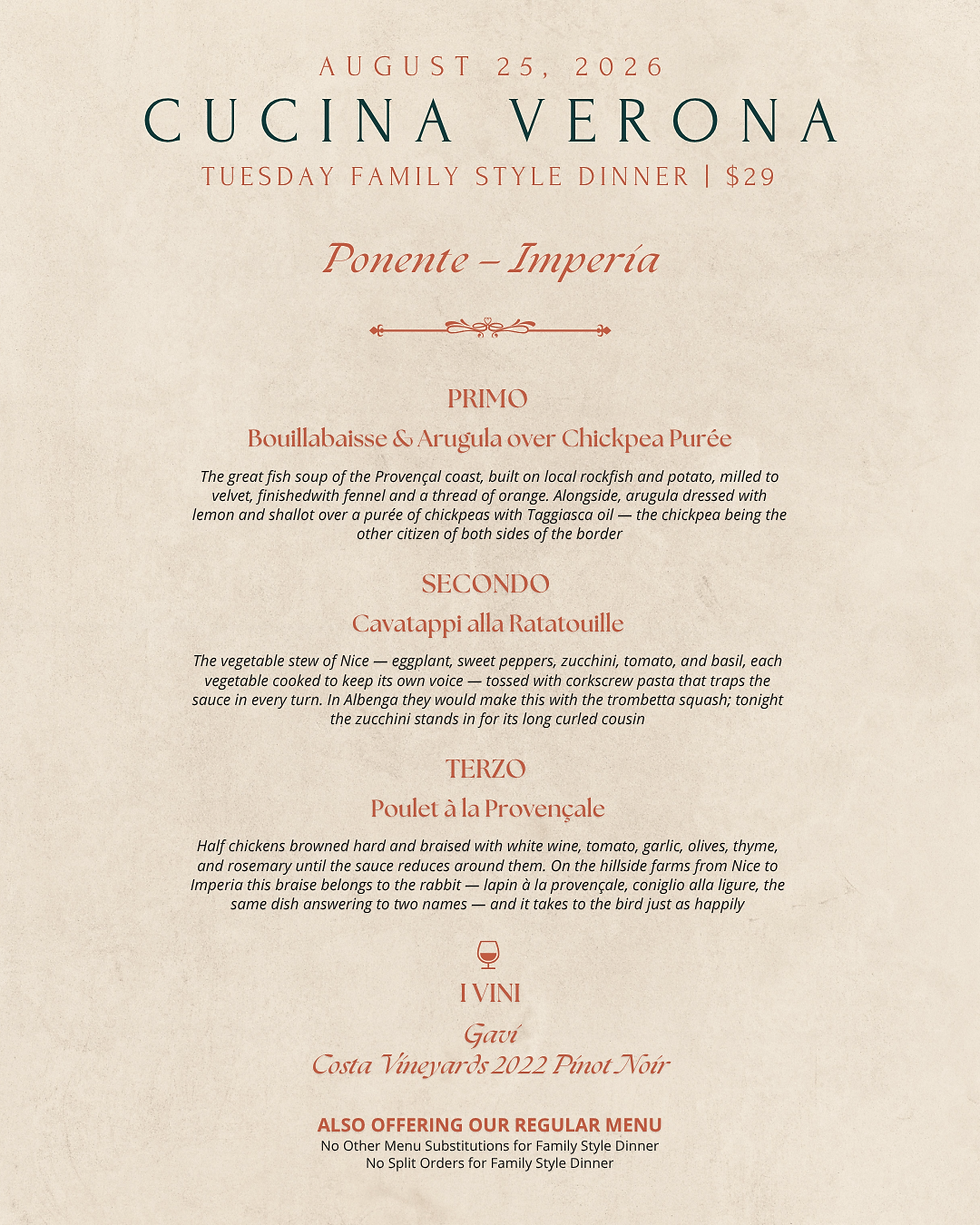
This is personal for me. My French training is Provençal at its core, and the longer I cook the clearer it becomes that the kitchen I was trained in and the kitchen of the Italian Ponente are the same kitchen with a customs post dropped on it in 1860. The chickpea, the anchovy, the ratatouille and its Ligurian cousins, the fish soup, the rabbit braised with olives and thyme, olive oil standing where the rest of France puts butter. Walk the market in Nice and the market in Oneglia in the same morning and you will need the parking signs to tell you which country you are in. Tonight's menu makes no apology for crossing the line, because the line is younger than the recipes.
One resident of Oneglia understood better than anyone what this coast offers. In the 1920s the most famous entertainer in Europe, the Swiss clown Grock, the highest-paid performer of his era, a man who made Chaplin laugh, came to Imperia to visit his in-laws, fell in love with the place, and built himself a forty-seven-room folly on the hill above the harbor: Jugendstil crossed with Art Deco crossed with Persian pagodas, a garden full of fountains shaped like juggling clubs. He could have lived anywhere on the Riviera. He chose the town without the casino and without the postcard, and he stayed until he died there in 1959. The villa then rotted for forty years, the local kids used to cut school and sneak into its overgrown gardens, until the town itself bought it back, restored it inch by inch over two decades, and opened it as Italy's museum of the clown, sending the school kids back in through the front door. Nice would have made it a boutique hotel. Imperia taxed itself to make a public dream. A town that resurrects a clown's folly for its own children is a town that understands what it has.
The wines tonight tell the trade route. Liguria is a coastline, not a wine region, a shelf of terraced rock with no room to plant at scale, and what its ports drank came down the salt road from Piedmont, wine and hazelnuts descending, oil and anchovies climbing back over the Colle di Nava. The Gavi is that story in a glass: Cortese vines planted just over the mountains by Genoese nobility to supply Genoa itself, the white the Ligurian coast actually drank. And with the chicken we pour our own Pinot Noir from the Comptche ranch, the same wine that closed the Genoa dinner in April, tying the two ends of Liguria together across four months and one hemisphere of the year. It does here what a southern French red does at a table in Nice: sits down quietly next to the olives and the tomato, and lets them talk.
Reservations: (707) 964-6844 or click here
124 East Laurel Street, Fort Bragg, California