Valle d’Aosta: Two Valleys
by Joseph Harris
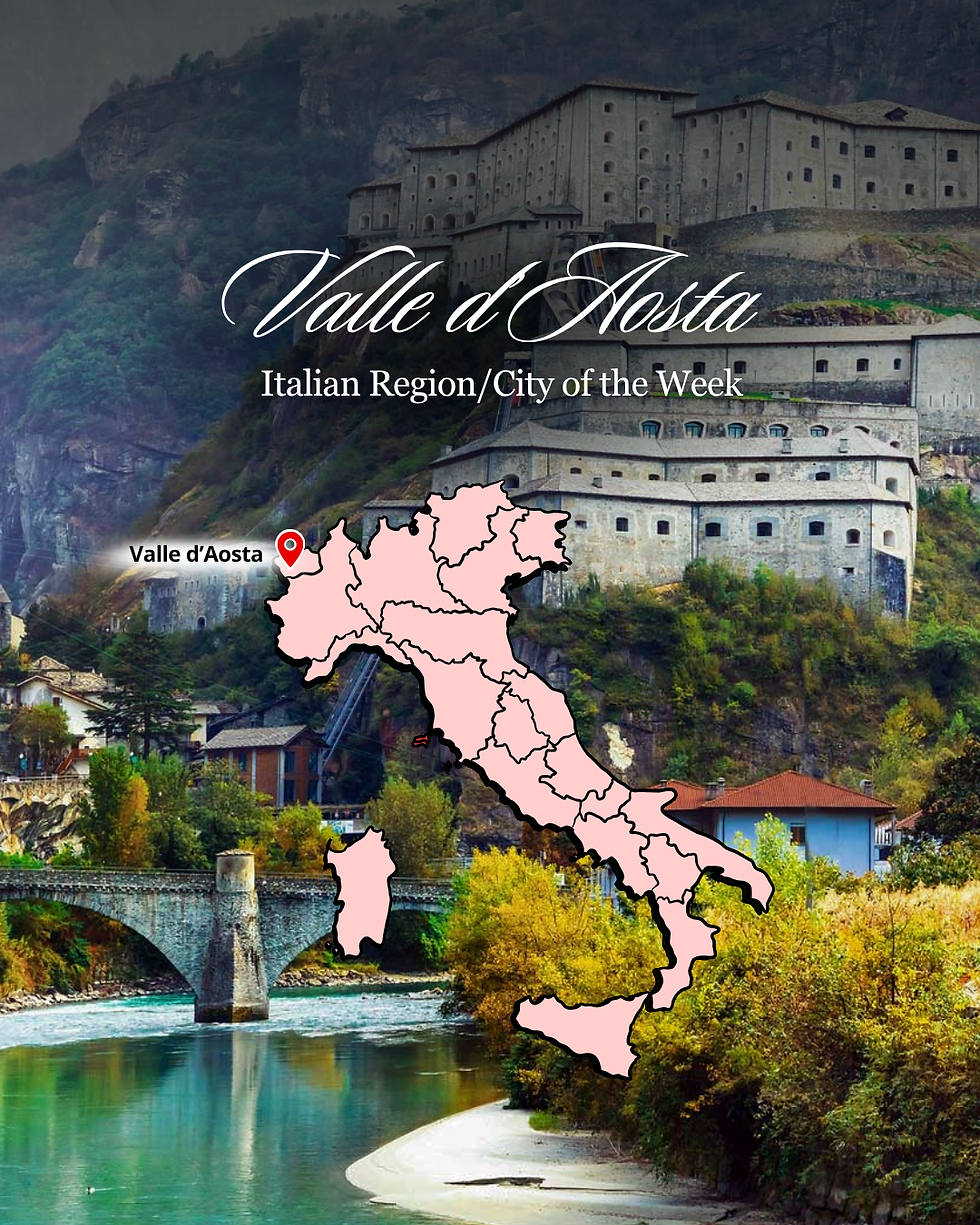
Italian ground. French vines. A Swiss neighbor.
Why is Valle d’Aosta in Italy at all? The people speak French. The cheese goes into a pot the way it does in Switzerland. The valley sits under Mont Blanc with France over one wall and Switzerland over the other, and for most of its history it had more to do with both of them than with anything south of Turin. It is the smallest region in the country, about 125,000 people in one long cut through the Alps. The answer to the question is a road and a family.
The road came first. Two passes leave the head of the valley: The Great St. Bernard, north toward the Rhine, and the Little St. Bernard, west toward the Rhône. Whoever holds the valley holds the door between Italy and the rest of Europe. Rome understood that. In 25 BC the legions of Augustus broke the mountain people who lived there, the Salassi, and built a city where the two roads fork. They named it for the emperor, Augusta Praetoria, and over the centuries the name wore down to Aosta. His arch still stands at the edge of town, and the streets still run on the Roman grid.
After Rome, everyone used the door. Pilgrims walked through it on the road from Canterbury to Rome. Napoleon took forty thousand men over the Great St. Bernard in the spring of 1800, on his way to beat the Austrians at Marengo.
The family came a thousand years after the legions. Around 1032 a mountain lord named Humbert, called the White-Handed, became Count of Aosta. He founded the House of Savoy, and the valley was one of the first things the family ever owned. They held it for nine hundred years, and they held it lightly. In 1191 the count granted the valley a charter of liberties, and the Valdostans ran much of their own business from then on. In 1561 the duke made French the language of law and government, which only wrote down what people already spoke.
Then the family grew ambitious. In the 1800s the House of Savoy, by then kings in Turin, set out to unite Italy under their crown, and they needed the French army to do it. The price was their own homeland. In 1860 they handed Savoy and Nice to France. Valle d’Aosta lay on the Italian side of the peaks, so it stayed with the king, and a year later the king was King of Italy. That is how a French-speaking valley became Italian. The family that had owned it since the Middle Ages moved downhill and took it along.
What is it like to be Italian there? For the first sixty years it was awkward. For the next twenty it was dangerous. Mussolini wanted one Italy with one language. He closed the French schools, pushed French out of public life, and in 1939 put Italian names on the towns. He brought in workers from the rest of Italy to run the steel mill in Aosta and thin out the locals. The valley answered with a notary named Émile Chanoux, who argued that mountain people on every side of the Alps had the right to govern themselves in their own language. In December 1943 he helped write that down in a declaration at Chivasso. In May 1944 the Fascists arrested him, and he was dead in his cell by morning.
When the war ended, French troops were in the valley and De Gaulle would have been glad to keep it. The Americans made him leave. Rome, to hold on to the place, gave it what Chanoux had asked for. Since 1948 Valle d’Aosta has been an autonomous region with its own parliament, and French stands equal with Italian in the schools and on the signs. At home many families speak neither. They speak patois, an old mountain tongue that is cousin to both. Up the Gressoney valley there are villages that still speak a German dialect their ancestors carried over from Switzerland centuries ago. Ask people there what they are and the first answer is Valdostan. Italian is the passport.
Who came from there? More than a valley that size has any right to. Anselm was born in Aosta around 1033. He walked out over the pass as a young man, became Archbishop of Canterbury, and wrote the most famous argument for the existence of God that anyone has ever tried to knock down. Philosophers are still at it. About the same time, an archdeacon of Aosta named Bernard built a shelter at the top of the pass for travelers caught in the snow. The monks who kept it later bred big dogs to find them, and the pass and the dogs both carry his name. In 1865 a guide from Valtournenche named Jean-Antoine Carrel climbed the Matterhorn from the Italian side, three days after an Englishman reached the top from the Swiss side. And in 1903 the first Tour de France was won by Maurice Garin, who was born in a village in the valley and left it as a boy to sweep chimneys in France, the way thousands of poor Valdostans did.
Put them together and you see why the place matters. It is the door, and its people are the ones who keep it: the saint with the shelter, the guides, the men who went through it to find work, and the philosopher who went through it and changed how Europe thought.
I have been cooking my way around Italy all year, and this is the first chapter where I kept forgetting which valley I was writing about.
The grapes tell it first. In Valle d’Aosta the vine follows the altitude. At the warm mouth of the valley, next to Piedmont, they grow Nebbiolo. Climb, and the grapes turn French: Pinot Noir, Gamay, Chardonnay. Higher up there is a white that came over the pass from Switzerland, and a little Gewürztraminer from the German side of the family. At the very top, under Mont Blanc, are some of the highest vineyards in Europe, growing a grape at the edge of where a grape will ripen at all. That is three languages of wine in one valley, sorted by cold.
Mendocino County does the same thing lying on its side. Our cold is west. On the coastal ridges out toward Elk, and at the far end of Anderson Valley, we grow Pinot Noir at the limit of what will work. Go inland and the valleys warm until they could pass for Napa. In between is everything else, French, Italian and German, each planted where the climate lets it live. I would argue that no county in California covers more ground between cold and warm. Our wine culture is like Switzerland’s: a little of each neighbor, and the microclimate decides.
Before the vines, both valleys grew apples. Valle d’Aosta is still known for its Renette. Anderson Valley was apple country from the start. The Andersons were among the first settlers in 1851, and Walter Anderson planted the valley’s first apple trees.
Then came the Italians, and then the Swiss, in that order, on the same piece of ground. A family named Pinoli farmed orchards and vineyards there in the early 1900s. Joe Pinoli put the first vines on the valley floor and opened the valley’s first bonded winery. In 1969 the Pinolis sold to a Swiss couple, Hans and Theresia Kobler, who turned the old barn into a winery. That was Lazy Creek.
Hans had been a waiter and maître d’ at Jack’s in San Francisco. His customers told him white wine was sour, so he poured them Gewürztraminer from Alsace. When he had land of his own, he planted four acres of it. Local lore says the Koblers carried their Pinot cuttings home from France in their suitcases.
Hans was an old friend. When I planted my own vineyard at Comptche, he gave me advice. When the vines gave their first crop in 2002, it came to three and a quarter tons, and we made the wine in the field boxes in his winery. The 2003 and the 2004 were made there too. So the Pinot in the glass tonight began in a Swiss man’s barn, on an Italian family’s farm, in a California apple valley. Theresia died this summer at ninety-two.
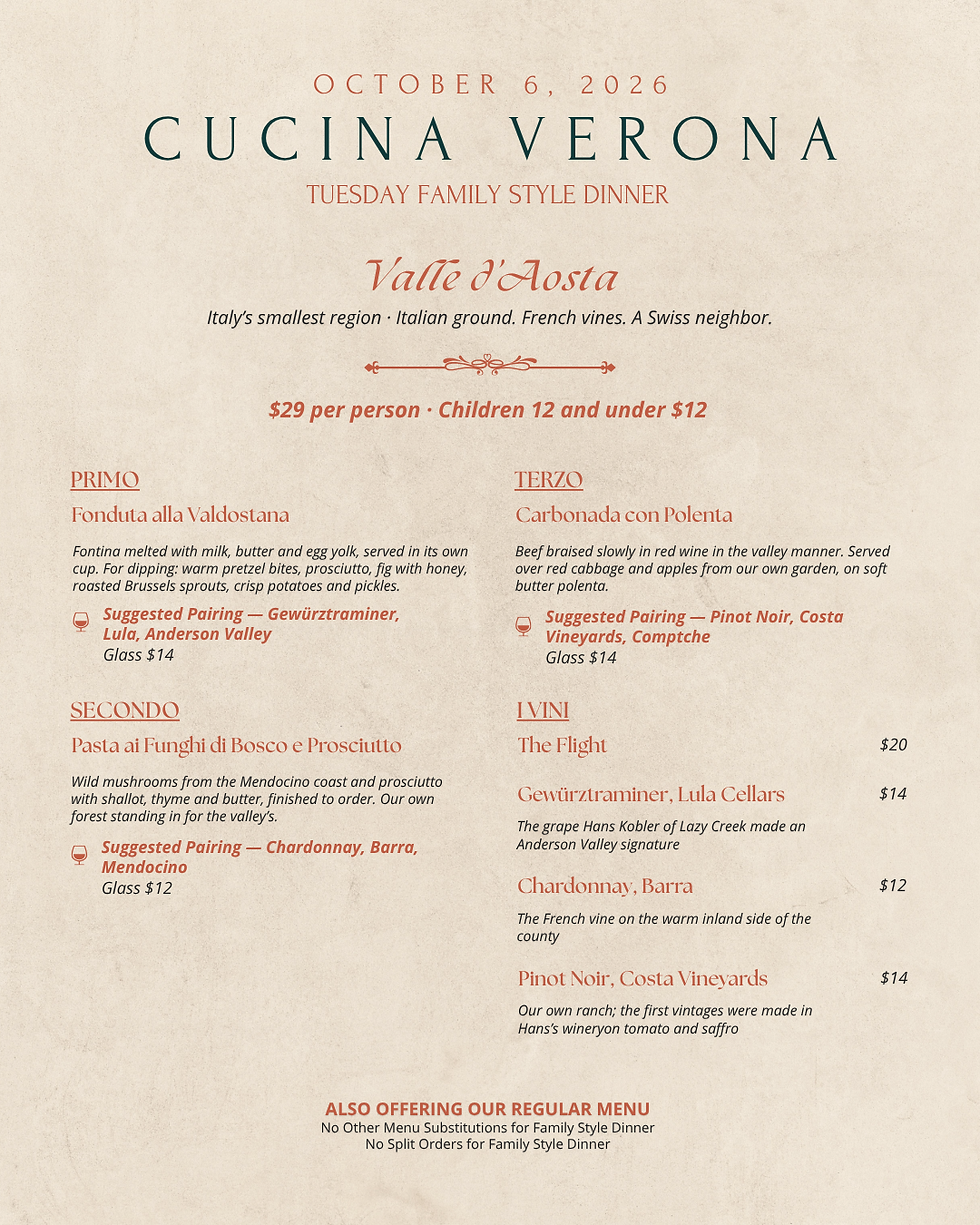
That is why this menu looks the way it does. The first course is fonduta, Fontina melted with milk, butter and egg yolk, served in its own cup with house-made pretzel bites, prosciutto, a fig, roasted Brussels sprouts and pickles to dip. With it we pour Gewürztraminer from Anderson Valley, Hans’s grape. The pasta is wild mushrooms from our own woods, with the Barra Chardonnay from the warm inland side of the county. The beef is carbonada, braised slowly in red wine, over red cabbage and apples from my own yard, on polenta. So the last plate has my apples under the beef and my Pinot beside it, and Hans somewhere in both.
Valle d’Aosta is the story of my part of the county. And frankly, it is more Swiss than Italian.
Reservations: (707) 964-6844 or click here
124 East Laurel Street, Fort Bragg, California