Mantua: The exile's town
by Joseph Harris

When the Prince of Verona banishes Romeo, the Friar tells him where to go: Mantua. It is twenty-five miles down the road, but it was another state under another lord, and Verona’s law stopped at the border. That is all exile meant in the Italy of the city-states. You were not sent to the ends of the earth. You were sent to the next town, and to the people who sent you it was the same thing. Romeo says there is no world outside Verona’s walls, only purgatory, torture, hell itself. When he gets to Mantua, the one citizen Shakespeare shows us is a starving apothecary who sells him poison.
It is easy to see why Mantua got the part. It sits low in the Po plain, and in the twelfth century an engineer dammed the Mincio and wrapped the city in lakes. From then on it was an island in a marsh, with fog in winter and fever in summer. A place that hard to get into is just as hard to get out of, and outsiders used it that way for centuries. Napoleon starved an Austrian army inside it. The French shot the Tyrolean rebel Andreas Hofer there. The Austrians, once they had it back, made it a fortress and a prison and hanged Italian patriots at Belfiore, just outside the gates.
Those gallows were going up in the same years Verdi’s Rigoletto was new. He had taken a French play about a French king who ruins his jester’s daughter. The Austrian censors would not let a king be shown that way, so the king became a duke and the court was moved to Mantua. The choice was no compliment. The Gonzaga had died out a hundred and forty years earlier, the last duke in exile himself, so there was no one left to insult. Mantua was the place where you could put a libertine, a hired killer and a curse, and nobody would complain.
Even now Mantua is mostly a town people pass. It lies on the road from Verona to Parma, the old way down from the Alps to the crossing of the Po, and travelers have always treated it as a place to spend a night and move on to somewhere they had heard of.
That is Mantua from the outside, and the famous view of the city is exactly that: towers and domes seen from the far shore of the lake. Everything that matters is on the other side of the bridge.
Inside, the Gonzaga ruled for nearly four hundred years. In 1423 they opened a school called the House of Joy, where the prince’s children and poor scholars learned at the same benches. Mantegna spent nine years painting a single room for them. Isabella d’Este kept the most admired court in Europe here, and Rubens was the court painter. In 1607 Monteverdi staged Orfeo in the ducal palace, the first great opera. Verdi set his curse in the city that gave him his art.
Look at who came from here. Castiglione wrote The Courtier, the book that taught Europe its manners. Teofilo Folengo, a monk, made famous a comic verse named for macaroni, and his muses live on a mountain of grated cheese. A Gonzaga prince gave up his title, died nursing the sick, and became Saint Aloysius, which is why Americans know the family name from a basketball team in Spokane. Tazio Nuvolari, the Flying Mantuan, may have been the greatest racing driver who ever lived. Arnoldo Mondadori built Italy’s largest publishing house. And after the battle of Solferino, in this province, the women of the next town nursed the wounded of both armies, and a Swiss traveler who watched them went home and founded the Red Cross.
First among them is Virgil, a farmer’s son born in these fields. Rome took his neighbors’ land to pay its soldiers, and the poem that made his name is about a farmer driven off it. Outsiders saw Mantua as the place you were exiled to. Its own poet wrote about it as the home you were exiled from. Thirteen centuries later Dante, the most famous banished man in Italy, needed a guide through hell and chose the Mantuan.
The land Virgil farmed is still the point. This is the heart of the north: the middle of the great plain, far from the sea, with rice and polenta coming down the road from Verona and stuffed pasta and grana coming up it from Parma. Venice looks east. Mantua is the plain itself. The Austrians and the French both held it, but they held the fortress, not the kitchen. When France taught the rest of Europe to keep sweet and savory apart, Mantua had no court left to follow the fashion and was not important enough for anyone to insist. So the old taste stayed: sweet against sour, spice, fruit and vinegar, on the food of the wet fields. The lakes did the rest. An island people keeps a full larder, and salami, grana and fruit preserved in mustard are all foods that wait.
Described from outside, it sounds wrong. Almond cookies on squash? Raisins and vinegar on duck? The Gonzaga cook Bartolomeo Stefani wrote it all down in 1662, and Mantua still eats that way.
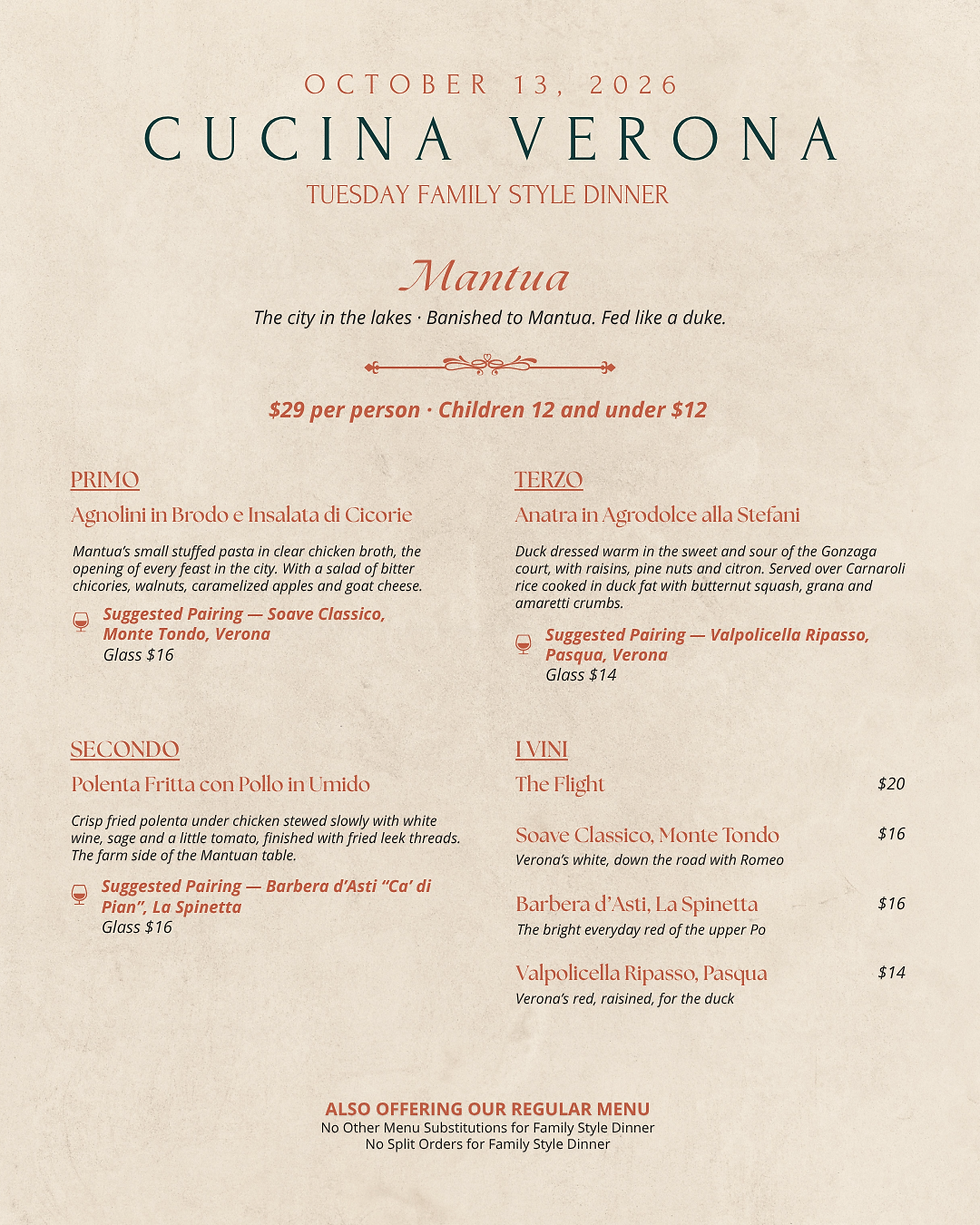
Our dinner runs the road in order. It opens with agnolini from the Parma side, in broth. The farm comes next, polenta and chicken. At the end is Stefani’s sweet and sour on duck from the lakes, over rice from the Verona side, and the plate carries the squash, the grana and the amaretti of Mantua’s famous tortelli.
So tonight we follow Romeo down the road from Verona, which is our road too, since this house carries Verona’s name. He thought he was being sent to hell. He was being sent to a better dinner than the one he left.
Reservations: (707) 964-6844 or click here
124 East Laurel Street, Fort Bragg, California