Trapani: The Port That Ate Its Own Trade
by Joseph Harris
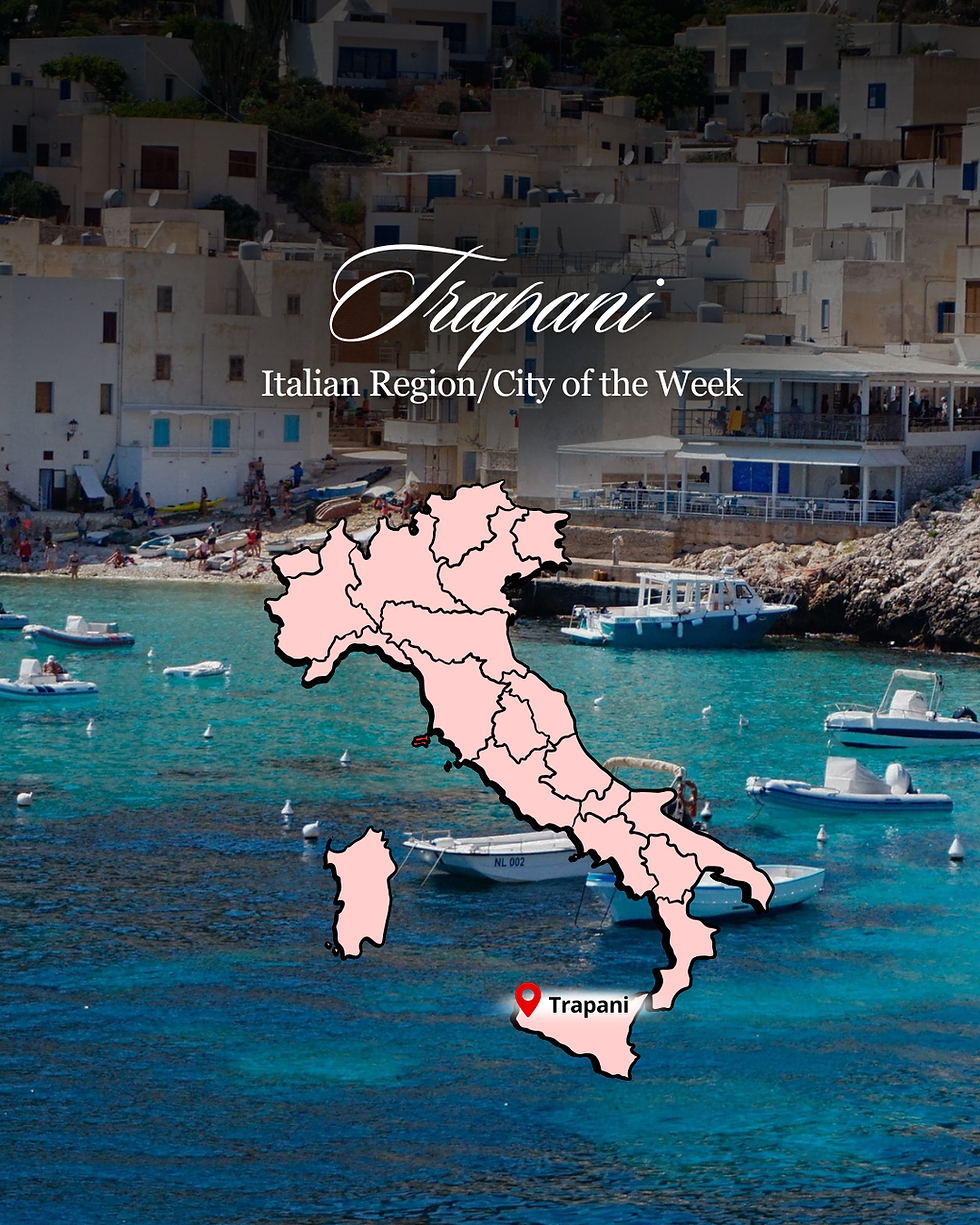
La Sicilia Occidentale · the rulers left, the people stayed, the food remained
The first Sicily chapter in this book made an argument about the whole island: that Sicily is what fusion cooking looks like when nobody is performing it, three thousand years of the same ingredients passed through different hands until the harmony had the integrity of a thing that simply accumulated. I stand by every word of it. But an island is too big a table to set on a Tuesday. This chapter is one port, on the far western tip, where the argument can be made in three courses, and where something else about Sicily is easier to see. The Sicilians are a peasant people. Every ruler the island ever had was a layer laid over them, and every layer eventually peeled away. What is left is what was always there, the people, and the food each ruler left behind when he went.
The history of Sicily is told by the men who ruled it, because they are the ones who left records, and there is nowhere better to count them than from the walls of Erice, the mountain town that hangs two and a half thousand feet above Trapani's harbor. On a clear day you can see the Egadi Islands, the salt pans, and, if you are willing to imagine a little, the coast of Tunisia ninety miles off. Everyone who came for Sicily came past this view. Below it, the whole time, the same families worked the same salt, netted the same tuna, and grew the same wheat. Keep them in mind as the rulers go by. They are the story.
The Elymians were here first, or first enough to count, and the Phoenicians of Carthage built a trading city on the lagoon island of Motya just down the coast, so that the earliest Trapani was already a port between two worlds. The Greeks came next and built Selinunte and Segesta in the interior, temples that still stand because nobody ever got around to knocking them down. The Greeks brought the olive and the vine and the idea that a meal was a civic occasion. They did not take the western tip; that stayed Punic. For three centuries the frontier between Greek Sicily and Carthaginian Sicily ran through this province, which is to say through the kitchen.
Rome settled the question. In March of 241 BC, off the Egadi Islands, in plain sight of Trapani, a Roman fleet built by public subscription met the Carthaginian relief fleet and destroyed it, and the First Punic War ended in the water outside this harbor. In the Rome chapter I wrote that Rome invited every people of the empire to the table except those who declined, Carthage in particular. Here is where the declining was settled. Sicily became Rome's first province and its granary, and for six hundred years the wheat that went out through Trapani fed the city that had beaten Carthage in front of it. The durum that makes the couscous and the bucatini on Tuesday night's card is the same wheat.
Then the empire came apart and the Byzantines held the island for three hundred quiet years, Greek-speaking and Christian, more concerned with Constantinople than with Trapani. They left the churches. They did not much change the food.
The Arabs did. In 827 an Aghlabid fleet out of Tunisia landed at Mazara, thirty miles south of Trapani, and for the next two and a half centuries western Sicily was part of the Islamic world, ruled from Palermo, tied by trade and blood to Ifriqiya across the strait. Everything that makes Sicilian food Sicilian rather than merely Italian arrived in those years: sugar cane and citrus, rice and the almond, saffron, the eggplant, the pistachio, the sweet-and-sour agrodolce, the pine nut and the raisin in a savory dish, the whole grammar of the pastry case. The Arabs enlarged the salt pans on the Trapani flats and organized the tuna fishery, and they brought couscous. Trapani is the only place in Italy where couscous is not an import but a native dish, steamed by hand over fish broth, and it is the clearest surviving evidence of who ran this coast when the dish took root.
The Normans, French-speaking adventurers out of the same stock that took England in 1066, took Sicily from the Arabs in the same generation and, being few and clever, kept the Arab administration, the Arab farmers, the Arab cooks, and the tonnara. Roger's court in Palermo spoke Greek, Latin and Arabic and ate accordingly. It is the moment Sicily's kitchen stopped being a battleground and became a synthesis. Frederick II, the Hohenstaufen grandson of that line, ruled a court of astronomers and falconers from here and was called the wonder of the world. Then the French came properly, the Angevins from Naples, and lasted sixteen years before the Sicilians rose at Vespers in 1282 and killed every Frenchman they could find. The Spanish, called in to replace them, stayed four hundred years. They brought the New World: the tomato, the chocolate, the pepper, the prickly pear. The red pesto of Trapani cannot be older than the Spanish tomato, which puts it, at the earliest, in the sixteenth century, and that is about when the story says it happened: Genoese ships in the Trapani roads on the Levant run, their sailors carrying the basil-and-garlic sauce of their own port, and the Trapani cooks rebuilding it with what the market had, which was almonds instead of pine nuts, and the ripe tomatoes the Spanish had made ordinary. Pesto alla trapanese is a Genoese idea with a Sicilian pantry, which makes it the most Sicilian dish on the card. Mine has one thing in it that no Trapani cook will admit to and every one of them would understand: the zest and juice of an orange, worked into the paste to loosen it in place of some of the oil. The orange is the Arabs' too. It belongs there.
After the Spanish the Bourbons, and after the Bourbons Garibaldi, who landed his thousand at Marsala, twenty miles down this coast, in May 1860 and took the island in a summer. And after the Italians, the Florios, the Palermo family who owned the Egadi tonnara and the Marsala trade and half the shipping in the Mediterranean, and whose mattanza at Favignana, the ritual netting and killing of the bluefin, was the last great industrial harvest of the ancient sea. The tuna are mostly gone now. The salt pans are still there, with their windmills and their white pyramids, and they are the foil of this chapter: the one thing every ruler found on this coast, used, taxed, and left in place, worked by the same people before and after. Salt is what Trapani had to sell. Couscous, tomatoes, almonds, sugar, basil were what it took in payment.
The salad on the card comes from an island that deserves a chapter of its own, and will get one. Pantelleria lies sixty miles southwest of Trapani and forty from Tunisia, which is to say it is closer to Africa than to Sicily, and it is the most stubbornly peasant place in the Mediterranean. It is a black volcano in the sea with no river, no spring, and a wind that never stops; the Arabs, who held it for four centuries and gave it half its words, called it Bent el-Rhia, the daughter of the wind. Everything the Pantescan built was built against that wind. The houses, the dammusi, are thick black lava cubes with white domed roofs shaped to catch the rain and run it into a cistern, because rain is the only water there has ever been. The vines are grown in hollows dug into the ground so that the plant lies below the level of the wind, a method so old and so particular that UNESCO has put it on the list of things humanity should not lose; the grape is Zibibbo, the Muscat the Arabs brought, and the wine made from it dried on straw in the sun is one of the great sweet wines of the world. The lemon trees stand one to a garden, each inside its own round stone tower with no roof, the giardino pantesco, a wall built for a single tree. And the capers, the best in the Mediterranean, grow out of the terrace walls on their own, are picked by hand at dawn before the flower opens, and are cured in the island's own sea salt, never in vinegar, which is the only way a caper keeps its taste. Rome exiled people here. Mussolini imprisoned them here. In June 1943 the Allies bombed it for a month and it surrendered before the landing, the first piece of Europe to fall, and the story goes that the only casualty on the beach was a soldier bitten by a mule. The Pantescans went back to their vines. That is the salad: potato, tomato, the capers, the salt, the oregano, the wind. It is a plate of exactly what an island with nothing was able to make out of nothing, and it is the argument of this chapter on a single dish.
So when I say this menu runs from North Africa to Genoa I mean it literally, and I mean it as a map of who governed the harbor and what they left in the kitchen when they went. The couscous is Tunisian and Arab, sweetened the Arab way with raisins and pine nuts and fennel, which makes the dish better. The salad is from Pantelleria, the island halfway to Africa, with its capers and its Trapani salt. The squash minestra is the last of a Sicilian summer, a dish so old and so poor that no ruler ever bothered to claim it; it is the peasant table itself, and it is on the card first for that reason. And the pesto is a Ligurian sailor's supper that came off a ship and never went back. Nothing on the card was invented in Trapani. Everything on it was finished there, by people who had no say in who ruled them and every say in what went in the pot. The Greeks are gone, the Arabs are gone, the Normans and the French and the Spanish are gone. The Sicilians are still there, and so is dinner. That is what a peasant people does with history: it eats it.

Reservations: (707) 964-6844 or click here
124 East Laurel Street, Fort Bragg, California


